Recap Recognition & Rewards Festival
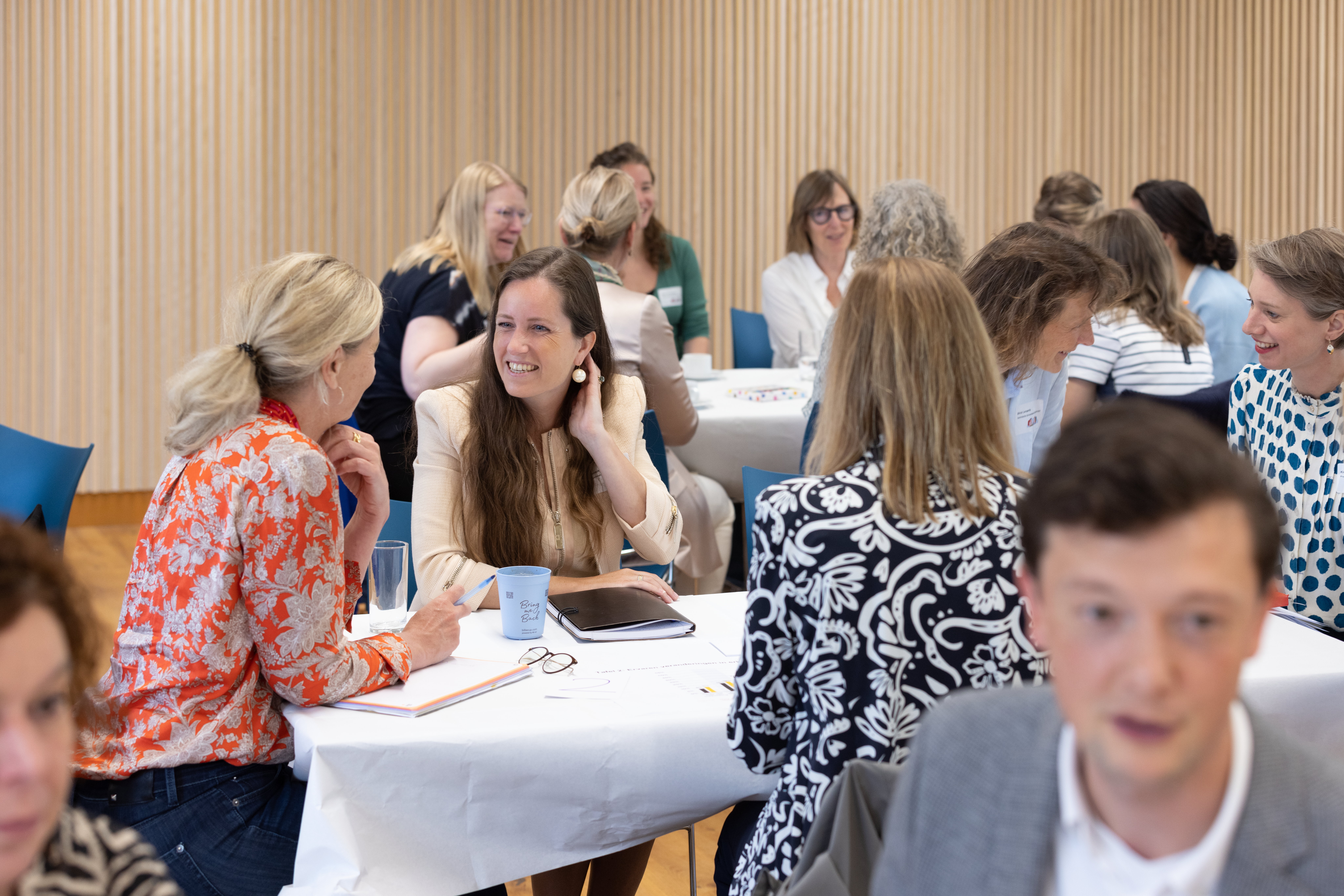

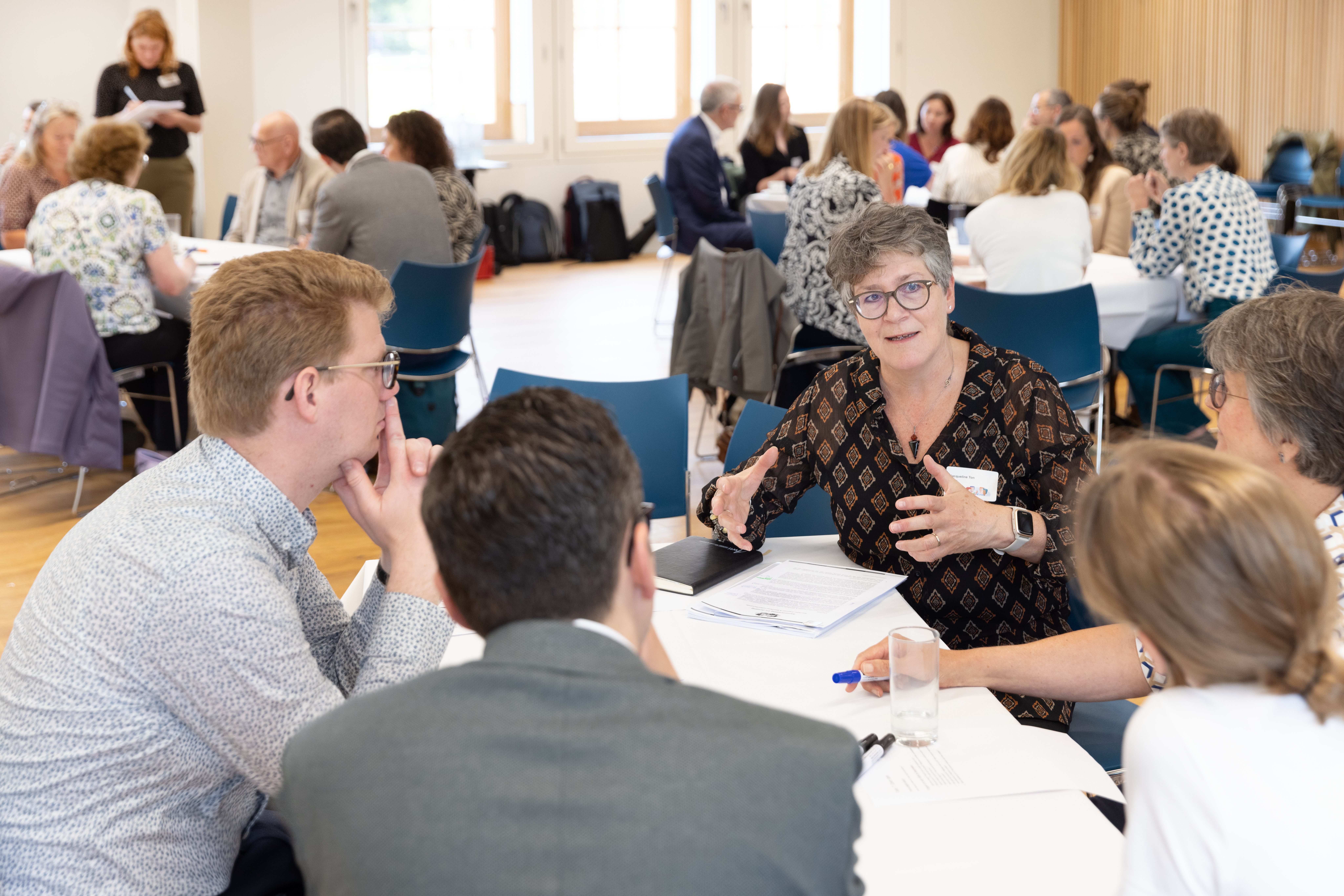
On Friday 8 November the fourth Recognition & Rewards Festival took place at the Mauritskazerne in Ede. Some 200 participants joint a varied programme around the theme ‘Developing diversified and talented teams’. We were delighted to welcome a diverse audience, including early career academics, deans, policy advisors and HR directors. We look back on an inspiring day with engaging panel discussions, interactive workshops and, of course, connecting and dialogue.
Plenary opening
The day was under the leadership of Jasmijn Mioch. As moderator, she opened the festival with some reflective questions. Participants were invited to reflect on the teams they are part of and which of those they find most rewarding. It turned out to be a good start to the dialogue. This was followed by a conversation with Jeroen Geurts (co-chair of the national steering group Recognition & Rewards), Kim Huijpen (national programme manager Recognition & Rewards) and Benthe van Wanrooij (chair of Promovendi Netwerk Nederland) about their thoughts on the theme and their expectations of the day. All three emphasized the importance of team collaboration. ‘A team is like an orchestra’, says Huijpen. ‘Every musician has a different talent and plays a different instrument. Playing in an orchestra is also about listening to each other and making sure that the person next to you will be heard. Together, the orchestra plays very beautiful music.’
Column
Following this opening, Karen Stroobants (vice chair of the Coalition for Advancing Research Assessment) was invited to deliver a column. She championed the proposition that a team is more than the sum of its talents. In her column, she speaks about ‘the sum+ team’. Such a team resembles an orchestra or a football team, and has two characteristics. On the one hand, this team consists of a diversity of profiles that complement each other. On the other hand, it is steered by a manager or leader who thinks strategically about talents, competences and backgrounds that are required to form the sum+ team and bring the team together around a common goal. The success of a team is often associated with its coach. Building on these two key characteristics, Stroobants finished her contribution with three concrete suggestions for people who are responsible for recruitment, development and fostering of teams. Firstly, she noted that funders, institutions and departments should give more weight to people management competencies of the team leaders they hire, promote and fund. Where management competences are required to deliver in a role or project, this must be reflected in funding and promotion criteria. In addition, she recommended that funders, institutions and teams stop desiring the ‘jack-of-all-trades’. Finally, she advised that actors reflect on what is appropriate to assess at the individual and what is arguably better evaluated at the level of the team.
Panel discussion
The third part of the programme featured a panel discussion. Sanli Faez (board member of The Young Academy) and Sean Sapcariu (programme manager at the Luxembourg National Research Fund) had a dialogue about assessing research performance and using narrative CV’s. Sapcariu is a warm advocate of the narrative CV. In his eyes, this is a tool that brings focus and consistency to recognising a broad range of achievements. Faez, however, was critical of its application in appointment committees: ‘A narrative CV gives a very limited aspect of the candidate. It is a very promise-based system and not a track record-based system. You don’t look at who has really delivered in the past on the promises or has done something that other people respect. The idea of committees is a steel in the optimalization of the system, and that’s why a lot of evaluations fail.’ Sapcariu countered that all is about trust. ‘We give money as an investment in ideas. Past success is not a guarantee for success in the future. It’s about good ideas and good teams.’
Later in the session, Gunther Cornelissen (academic director Mathematical Institute) and Renske Bouwer (associate professor in Language & Education) discussed team diversification. Cornelissen advocated for less evaluation and more recognition. Asked how to achieve this, he suggested: ‘Fewer steps in academic careers.’ Bouwer described herself as ‘a diversified person in herself’, combining various tasks and thriving in this multi-faceted role. However, she acknowledged that not everyone feels the same way and stressed the need to balance roles in research, teaching, and societal impact. ‘We need to find a way to balance the different roles in research, education and impact’. At the same time, the focus for many academics is on education. So, education deserves more recognition and rewards. It is crucial that people share positive stories about education. Thus, in her team the lab meetings for research are combined with the meetings on education: ‘We make room for people to bring in inspiring ideas related to both research, impact and education. Then you recognize all the different roles’.
The panelists concluded the conversation with a one-liner. What do you like the audience to remember from this panel conversation? Sapcariu answers: ‘Use the right words to change culture.’ For Faez the message is: ‘Speak up!’ Cornelissen wants to emphasize that working in teams makes you happy. Bouwer points out the importance of integrating the multiple roles of research, education and impact within the teams.
Workshops
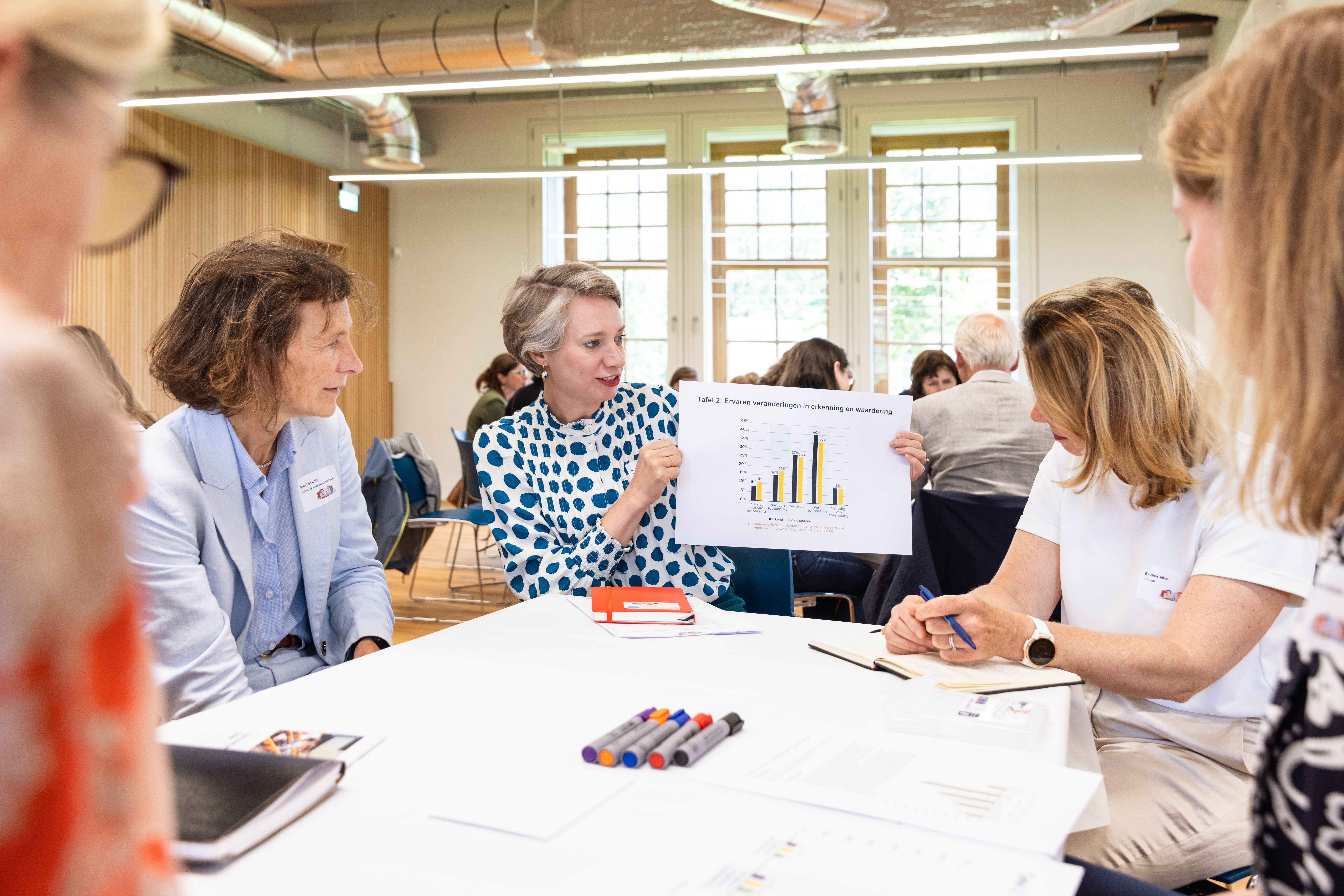
After this plenary part of the programme, two rounds of workshops took place in breakout rooms. Participants had the opportunity to join two workshops best suited to their interests. With twenty diverse sessions on offer, there was plenty to choose from. From pub quiz to serious game, and from building a talented team to reflecting on the recognition structure for individuals and teams. For this edition of the Recognition & Rewards Festival, we specifically invited various groups. Therefore, some workshops had also been organised for specific target groups, such as early career academics, committee members involved in promotion and appointments, and academics in leadership positions.
Team note
In the afternoon, the plenary programme turned to an international perspective. In a team note, three colleagues from Newcastle University presented how the developments around ‘Research culture’ in the United Kingdom relate to diverse and talented teams. Similarly to the Netherlands, improving research culture is high on the agenda for universities and research organisations in the UK. Candy Rowe, dean of Research Culture and Strategy at Newcastle University, described how a Wellcome Trust survey into experiences of thousands of researchers gave a strong evidence base for change of research culture. Rowe states that ‘Although the phrase “Room for everyone’s talent” is not widely used in the UK, we talk about something very similar. About it being important for diverse contributions to be valued and recognized.’
Closure
Mioch closed the festival by interviewing Kim Huijpen. As programme manager, what does she take away from the day? Her conclusion is short and sweet: ‘It’s all about words. I learned a new word or actually a new phrase today in a workshop. It is “diversity discomfort”. The idea is to sit with your discomfort because that enhances learning. Further, I hope we can express our recognition to each other and support each other in changing recognition and rewards in academia.’
It was again a successful Recognition & Rewards Festival, full of interaction and inspiration. We extend our heartfelt thanks to all speakers, panelists and workshop leaders for contributing to the programme. We very much appreciated the active participation of all the participants. We are looking forward to follow-up on all the interesting dialogues together.
Please have a look at the aftermovie, the photos and the recordings of the plenary sessions as well: