Onlangs verscheen er een uitgebreid artikel in De Psycholoog over Erkennen en Waarderen. Dit is een bewerkte versie van de afscheidsrede van Rector Klaas Sijtsma van Tilburg University waarin Erkennen & Waarderen centraal stond.
Klaas Sijtsma was van 2019 tot 2020 rector magnificus van Tilburg University en in die functie betrokken bij de implementatie van Ruimte voor Ieders Talent. Aan diezelfde universiteit is hij hoogleraar Methoden en Technieken van Psychologisch Onderzoek. Dit essay is een bewerkte versie van de dies-rede die hij uitsprak op 19 november 2020.
Dit artikel verscheen eerder op Universonline.nl en is geschreven door Ron Vaessen. Het artikel komt vanuit de Universiteit Tilburg.
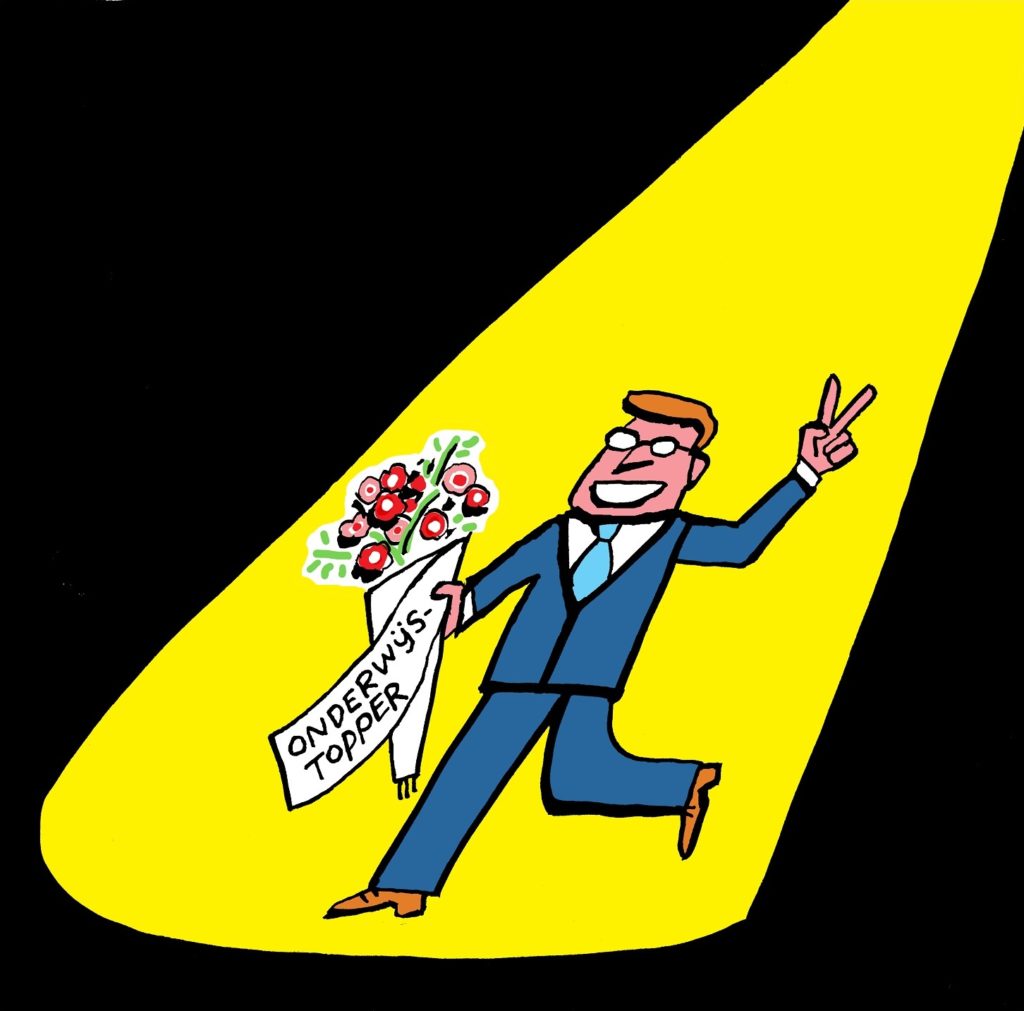
Toponderzoekers gaan hun plek in de schijnwerpers delen. Carrière maken aan de universiteit moet ook mogelijk worden als je een goede docent bent, of een leider. Maar hoe gaat Tilburg University de omslag maken en wanneer merken medewerkers hier iets van? Zeven vragen over het nieuwe erkennen en waarderen.
Beeld Bas van der Schot
Het is hoog tijd dat wetenschappelijk medewerkers meer gewaardeerd worden, besloten de veertien Nederlandse universiteiten in 2019. Nu krijgen de plannen verder vorm. Aan Tilburg University is er een stuurgroep opgezet die wordt geleid door emeritus hoogleraar Human Resource Studies Jaap Paauwe.
De komende tijd voeren ze gesprekken met medewerkers en in het najaar moeten er al serieuze beleidsvoorstellen op tafel liggen. Univers blikt vooruit met Paauwe en hoogleraar Communication and Technologies Marjolijn Antheunis en decaan van Tilburg Law School Geert Vervaeke, allebei lid van de stuurgroep.
1. Waarom is het nodig wetenschappelijk medewerkers anders te waarderen?
Je studenten mogen vinden dat je een kei bent, je kan steevast bijspringen als een collega ziek is of enorm helpen bij een beursaanvraag. Maar verwacht geen applaus als je die beurs niet zelf binnensleept of als de publicatie in het toptijdschrift niet op jouw naam staat. Onder de streep word je afgerekend op je eigen onderzoeksresultaten. De rest is bijzaak.
“Veel mensen halen voldoening uit het geven van onderwijs,” zegt Marjolijn Antheunis. “Maar het wordt ook als een noodzakelijk kwaad gezien, omdat het ten koste gaat van je onderzoeksoutput en dus eventuele waardering, bevordering en een beurs in de weg zit.” Jaap Paauwe ziet dit ook gebeuren: “Een universitair docent die veel passie heeft voor onderwijs, daar wordt een beetje op neergekeken.”
De wetenschapper lijkt tegenwoordig wel een one-trick-pony, zegt hij, die vooral goed is in onderzoek. “Dat doet geen recht aan je functie als academicus.”
2. Hoe moet het dan wel?
“Het moet volkomen legitiem worden om je te specialiseren in onderwijs,” zegt Paauwe. Het idee is dat wetenschappers voortaan zelf kiezen hoe ze hun loopbaan indelen. Er zijn vijf domeinen waarop medewerkers de nadruk kunnen leggen: onderwijs, onderzoek, impact, leiderschap en team spirit. Er wordt gedacht aan profielen om uit te kiezen.
“Onderwijs en onderzoek zijn de basis,” zegt Antheunis. Daar kan niemand omheen. “Maar als je excelleert in onderwijs en onderzoek gewoon goed doet, kan je nog steeds groeien.” Een departementshoofd die leiding geeft en ook goed onderwijs verzorgt, hoeft dus niet uit te blinken in onderzoek.
Zo wordt de weg vrijgemaakt voor allerlei talenten die nu onopgemerkt of ondergewaardeerd blijven. Paauwe: “We blijven topwetenschappers koesteren, maar niet meer als enige.”
In het begin van een loopbaan doen medewerkers ervaring op in alle domeinen. Paauwe: “Zo weet je waar je sterktes liggen.” Met meer ervaring wordt het mogelijk om het zwaartepunt te verleggen, zegt Geert Vervaeke. “Mensen hoeven niet meer alle vaardigheden ineens te ontwikkelen, maar doen dat gedurende vijf á tien jaar.”
Het moet allemaal een stuk flexibeler worden. Als de situatie erom vraagt, kan een wetenschapper bijvoorbeeld tijdelijk meer onderwijs geven, zonder daarop te worden afgerekend.
3. Wat wil ‘team spirit’ eigenlijk zeggen?
Dat het normaler gaat worden om in teams te werken. En dat gebeurt volgens de drie eigenlijk al. Wetenschappers zijn heus niet alleen met zichzelf bezig. Ze springen bij in het onderwijs, helpen met het oefenen van een presentatie. Maar tot nu toe werden ze dus vooral afgerekend op de eigen onderzoeksprestaties.
“Mensen die in de gaten springen zijn cruciaal, maar dat wordt nu voor lief genomen,” zegt Antheunis. “Veel collega’s willen graag samenwerken. Het verbetert hun onderzoek en inzichten, alleen voorheen moesten ze toch voor de eigen zaak vechten.”
Er wordt een mentaliteitsverandering nagestreefd. Vervaeke: “We zouden samen feest moeten kunnen vieren als een collega een toppublicatie heeft. En die collega zou blij moeten zijn dat anderen taken hebben overgenomen. Want als je een toppublicatie hebt, heb je de ruimte gekregen van je organisatie om dat te realiseren.”
Lees verder na de afbeelding
Beeld Bas van der Schot
Meer denken vanuit het team en minder vanuit het individu. Samen verantwoordelijkheid nemen, voor doelen van het departement of de faculteit. Paauwe: “De verwachting is bijvoorbeeld dat je als compleet team straks verantwoordelijk bent voor de bachelors of masters, en daar verschillende rollen in vervult.”
Of samen werken aan de grote uitdagingen van deze tijd, zoals klimaatverandering of groeiende inkomensongelijkheid. “Complexe maatschappelijke vraagstukken vereisen steeds meer de samenwerking in teamverband vanuit verschillende functies en disciplines.”
4. Dat lijkt tegenstrijdig. Er komt meer nadruk te liggen op de wensen van het individu, maar tegelijkertijd wordt het team belangrijker. Worden mensen dan niet alsnog gedwongen om een bepaalde taak uit te voeren?
“Gedwongen is geen term die past bij Erkennen & Waarderen, of in de academische wereld. Dat schuurt enorm,” zegt Vervaeke. “Maar soms zijn er dingen die moeten gebeuren in een team. Dat is nu ook zo. Bijna alles van ons werk is fantastisch, maar niet alles.” Het wordt een puzzel die medewerkers samen gaan leggen, denkt hij.
“In de kern gaat het om het versterken van talenten”, zegt Antheunis. Natuurlijk kan niet iedereen zich volledig richten op onderzoek, dan zouden de collegezalen leeg zijn. Maar het punt is dat niet iedereen alleen maar onderzoek wil doen. Talenten liggen soms juist elders.
En als een medewerker toch toponderzoeker wil worden, maar eigenlijk vooral goed is in het geven van onderwijs? Dan is het zaak een spiegel voor te houden. “Maar er zal nooit gezegd worden: ‘Je mag dit niet doen, of je moet dat doen.’”
5. Hoe worden wetenschappers straks beoordeeld?
In de resultaat & ontwikkelingsgesprekken (R&O) zijn de vijf domeinen al opgenomen, zegt Paauwe. Het wordt mogelijk zelf accenten te leggen. Ook is het de bedoeling dat de kwantitatieve maatstaven zoals impact factor en h-index een kleinere rol gaan spelen. Maar wat komt ervoor in de plaats, en hoe wordt voorkomen dat het subjectieve oordeel van de baas een te grote rol speelt?
“Een idee is om naar gedrag te kijken. Bij leiderschap en team spirit kun je bepaalde gedragingen benoemen en vragen of iemand dat herkent,” zegt Paauwe. “Iemand die de gaten dichtloopt, dat is een magnifiek voorbeeld van team spirit.” Daar kan het gesprek dan over worden gevoerd.
Vervaeke wijst erop dat vakgroepvoorzitters “dicht bij de mensen zitten” en “veel informatie hebben”, wat zou helpen een eerlijk oordeel te vormen. Ook denkt hij dat Tilburg University hier een streepje voor heeft. Met het programma Connected Leading worden leidinggevenden al langer getraind ‘zelfreflexief’ te zijn, “hun eigen voorkeuren of afkeren te ontdekken en die op de meest positieve manier in te zetten. Niet ten nadele van de mensen waarmee ze samenwerken.”
6. Wanneer gaan medewerkers hier iets van merken?
“In het najaar zou er al veel gerealiseerd moeten zijn,” zegt Paauwe. Dan zijn er naar verwachting nieuwe richtlijnen en criteria voor de R&O-gesprekken, benoemingsadviescommissies en bevorderingen. In 2022 moet het allemaal langzaam indalen. “Je gaat mensen dan trainen en laten oefenen met de nieuwe criteria en wegingen.”
Eigenlijk is een nieuwe universiteit dus al in zicht. “Iemand van de universiteitsraad noemde mij naïef,” zegt Paauwe. Daar herkent hij zich niet in. Hij is ambitieus, ja, maar vooral optimistisch. De plannen zijn breed gedragen, de tijd is er rijp voor.
Al weet Paauwe vanuit zijn vakgebied heel goed dat grote veranderingen een lange adem vereisen. “We hebben te maken met een cultuurverandering,” zegt ook Geert Vervaeke. “De uitkomst daarvan ga je pas op middellange termijn zien. Over vijf, tien, twintig jaar.” Marjolijn Antheunis: “Het kost gewoon tijd.”
7. Vertraagt het coronavirus de plannen niet?
Niet echt. Paauwe had liever fysiek aan tafel gezeten met het wetenschappelijk personeel. Dan kan er eens iemand boos worden en met de vuist op tafel slaan, of een grapje maken. “Ik had me daar op verheugd, dan ontmoet je de mensen echt. Je mist nu een deel van de lichaamstaal en passie. Maar corona is geen reden om het allemaal uit te stellen.”
Het gaat wel lukken om met medewerkers in gesprek te gaan over de plannen, denkt Antheunis. Ook achter een webcam. “Uit onderzoek weten we dat online dialoogsessies niet veel afdoen aan de inhoud.” Ze is vooral blij dat de stuurgroep, met Paauwe voorop, heeft doorgezet, ondanks alle druk die corona meebracht. “Dit laat zien welk belang we eraan hechten. We willen de academie gezonder maken.”
Meer over de planning en voortgang van Erkennen & Waarderen binnen de Universiteit van Tilburg vind je op de intranet-pagina van de universiteit.
Leiden University has an active open science community. Open science means transparency in all phases of research by precisely documenting every step of the way and making this publicly available. ‘It’s time to be open,’ say psychologists Anna van ’t Veer and Zsuzsika Sjoerds. There is increasing awareness of the need for open science, or open scholarship as it is sometimes called, also at Leiden University.
Perhaps it’s no coincidence that psychologists Van ’t Veer and Sjoerds are advocates of open science. Because theirs is one of the disciplines in which studies have been replicated in recent years but did not always produce the same results. How this could be has generally remained unanswered, since it was not possible to establish exactly how the researchers had achieved their results in the first place. The premise of open science is to make science more traceable.
Anna van ‘t Veer: ‘Open science is very practical.’
Behaviour change
Open science is a broad, overarching theme, the researchers explain. It ranges from being aware of human bias – unconscious prejudices or assumptions – to publishing in open access journals. But it is also very practical: a different mentality and working method that requires behaviour change. The brainwork often ends up more towards the start of the research process. This means precisely planning, explaining and documenting aspects such as the hypothesis, methodology, process and data analysis. This removes any flexibility that might prompt decisions that would lead to the desired (often positive) result.
Equally important is to keep a record of the ins and outs of the research, not only for your own benefit but also for others to reproduce and replicate the research. Van ‘t Veer: ‘The principle of transparency runs through the project from beginning to end.’
Sjoerds: ‘It’s also important to make the data and materials FAIR: Findable, Accessible, Interoperable and Reusable.’ This concept has gained wide recognition. ‘At the start of a project,’ Sjoerds continues, ‘it’s already covered in the Leiden data management plan, and at the end, if we make the work more accessible through an open access publication. Transparency is also making a preprint public before journal submission, and even the reviews.’
FAIR (graphic: Sangya Pundir).
Learning from other disciplines
At the last count, around 700 people at 11 universities in the Netherlands were active in an open science community, which means our country is taking the lead. The open science community includes not only scientists and lecturers but also IT specialists, library staff and other support staff. They document scientific research, so have an important role in the scientific infrastructure, making them natural open science partners.
The open science community helps people learn from one another in the most efficient way possible. One discipline knows more about one aspect, whereas another discipline knows more about another. The community’s workshops are often very practical, covering, for instance, how exactly to describe everything precisely beforehand. That is a skill that you have to learn. Van ‘t Veer: ‘My first pre-registration probably wasn’t very good, but the point is that you learn by doing.’ Many disciplines, she adds, now face the challenge of learning the art of advance planning and making their choices transparent. ‘But I hear from colleagues that the first hurdle, working out how to do that, is the most challenging and once you’ve cracked that, it’s easy to get behind the new method of working. After all, research is about generating reliable knowledge for society. Some researchers are relieved even, because during the analysis they no longer have to think: if I tried something else, would that be significant?’
Zsuzsika Sjoerds: ‘Researchers are already used to many aspects of open science.’
Baby steps
If this new working method is so important, why isn’t everyone doing it already? Sjoerds: ‘Scientists feel that it is a lot of work and that they don’t have time for it. What I always try to tell them is that they do a lot already. They record much in advance in ethics proposals and data management plans, and often publish open access. Making datasets available is on the rise as it is. And I tell them it’s about becoming more aware and restructuring your habits, and therefore often about baby steps.’
Van ‘t Veer: ‘Awareness and motivation are important. Checklists alone are not enough. That won’t achieve optimal science. Change takes time, and the departmental culture and leadership are very important too. But it will ultimately pay off in terms of quality, and later still, in terms of time. The science of the future will be more transparent, and therefore more open for correction. Recognition of this is also changing. Alongside the university’s open science programme, you can currently see this in the national Recognition and Rewards programme that is running in Leiden.’
Figurehead
The university now has an open science figurehead: Paul Wouters, dean of the Faculty of Social and Behavioural Sciences and keen supporter of open science. The Executive Board is also an advocate, and there is a workgroup with linking pins, including Van ’t Veer, the holders of the open science portfolio in the Strategic and Academic Affairs directorate at the Administration and Central Services department and Leiden University Libraries, and there is a sounding board with representatives from all the faculties. But will it be enforced? No, that’s not how it works at a university. It’s about facilitating, ensuring that it’s easier for everyone to take the necessary steps and to gently steer them in the right direction.
Van ‘t Veer: ‘Ultimately the increasing recognition that open science will be essential will one way or another result in legislation in the national or international arena. The good thing about the combination of bottom up and top down is that we can give shape to an open future together.’
With Academia in Motion, Leiden University has joined the national initiative for a new form of recognition and rewards in academia.
The paper is the result of many discussions that the members of the steering group held at the faculties. Manon van der Heijden and Sarah de Rijcke are the chairs of the steering group. Van der Heijden is Academic Director and a professor at the Institute for History. De Rijcke is Scientific Director and Professor of Science and Evaluation Studies at the Centre for Science and Technology Studies. What do they hope to achieve?
Address the imbalance in duties
The staff workload is an important issue. One reason why this is too high, say the two chairs, is because too much emphasis is placed on research performance, whereas teaching and societal relevance are undervalued. Van der Heijden: ‘The balance in these tasks and their recognition is skewed. This is a problem if you want to become an associate professor and are only assessed on your research, when 80 percent of your duties consist of teaching.’
Eliminate simplistic criteria
Another shortcoming is the way in which the quality of research is valued and measured. This is generally with simplistic quantitative indicators, such as the number of academic publications and the journal impact factor, which indicates how often an academic journal is cited. De Rijcke: ‘This is now also used to assess individual researchers when it is in fact a measure of a journal. The risk of using unsuitable one-dimensional measures is a possible narrowing of the research space.’ Only suitable criteria should be used in evaluations, and there should be more room for the quality and creativity of staff.
More recognition of team performances
Academia in Motion is also calling for more recognition of team performances. Van der Heijden: ‘In Leiden a great deal of attention is paid to the ambitions of that brilliant researcher who receives plenty of recognition, but such performances are possible because that individual works in a good team or institute. Too much attention for the prima donnas comes at the expense of the team.’
De Rijcke adds: ‘When I was following training on applying for an individual grant I had to learn to stop saying “we” because apparently I would stand less of a chance. That didn’t do justice to the reality.’
Fortunately, grant providers like the Dutch Research Council (NWO) and umbrella organisations like the Association of Universities in the Netherlands (VSNU) and the Royal Netherlands Academy of Arts and Sciences (KNAW) also believe that the system should change and are working on a different application and assessment method.
Response from Vice-Rector Hester Bijl
Academia in Motion has the full backing of the Executive Board. Vice-Rector Hester Bijl supports the steering group’s findings and is pleased that the paper clearly describes the ambitions and main obstacles. In a response, she said: ‘This paper offers some good ideas on how to effect a much-needed culture change. Over the coming months we will all be discussing how to give this concrete shape. Obviously, it’s not something that you just roll out, but it begins with identifying the problems and gaining more awareness throughout the organisation of how we can do things differently.’
Share best practices and recognise differences
Bijl, Van der Heijden and De Rijcke all point to the many good initiatives that are already underway. The national Senior Teaching Qualification programme and the associate professor promotion pathway demonstrate greater recognition of the teaching, as do various faculty initiatives. De Rijcke: ‘The trick is to make the good examples more visible and to share them more with one another.’ That is not to say that the solution will be one size fits all. The paper emphasises that differences between disciplines and institutes should be taken into account.
Join dots with the strategic plan
The steering group hopes to be able to carry out a survey in February of differences in careers, transparency and leadership. And it may enlist focus groups to further develop the plans. De Rijcke: ‘When the steering group has finished this won’t mean that the process is complete. What we will have are pointers and scenarios for which steps to take next. And there is plenty of opportunity to join the dots with the strategic plans of the University and the faculties.’
Van der Heijden adds: ‘This is a long-term development that will happen in steps as it gains the buy-in of the wider organisation.’
Share experiences in national movement
De Rijcke and Van der Heijden are also in close contact with the chairs of similar steering groups at other Dutch universities and in regular international consultation. Van der Heijden: ‘A lot of information is exchanged about good practices and the different takes on recognition and rewards.’
De Rijcke: ‘It’s a national movement with a local translation in all the different steering groups. In Leiden we have consciously chosen a bottom-up process because it won’t work otherwise.’