
 by
by Report: Recognition & Rewards Thematic Session on quality features – 5 September 2024
Many academics feel there is a one-sided emphasis on (quantitative) research performance, frequently leading to the undervaluation of the other key areas. That is why the institutions want to recalibrate and broaden the assessment system for academic work, so that academics can distinguish themselves not only in research, but also within the domains of education, impact, leadership, and patient care. In doing so, it is crucial to define which quality features will be used in the different domains. Consequently, all partners in the national Recognition & Rewards programme have committed to specifying which quality features will be used in the different key areas (education, research, leadership, impact and patient care) with respect to the recruitment, development, appointment and promotion of academic staff. In the road map Room for everyone’s talent in practice we also emphasized that in doing so, we will take into account differences between disciplines, share good practices and engage in national coordination where possible. That’s why the Recognition & Rewards thematic meeting held on 5 September was dedicated to this issue.
Opening
The room on the sixth floor of La Vie Meeting Centre was well attended as Jeroen Geurts and Rianne Letschert open the meeting. In their opening words, they highlighted the importance of broadening the assessment system. The results of the Recognition & Rewards Culture Barometer show, for example, that academics want career progression to depend not solely on research achievements, but also activities in the field of education, leadership and impact. It is precisely in these areas that assessment is not yet sufficiently developed. ‘In collaboration with the various discipline consultations (in Dutch: disciplineoverleggen), we will explore in the coming period which quality features fit each scientific discipline and how these are in line with Recognition & Rewards.’
Keynote lecture
Next, Ruth Graham gave her keynote lecture. Graham is the initiator of the Advancing Teaching Network, created to improve the recognition, rewarding and evaluation of university teaching. One of its ongoing projects is mapping the changes currently taking place worldwide, including highlighting best practices. Graham observes in this Global mapping project that universities tend to adopt institution-wide standards, which are then implemented at a local level. Graham shares that universities however struggle with assessing university teaching in a right way. There are definitely some good examples of universities developing assessments of the quality and impact in teaching and learning. These assessment systems are often based on clear standards for university teaching. Furthermore, candidates are mainly assessed by internal promotion committees and external referees. According to Graham, it is a challenge also because now mainly research performance is the primary criterion for promotion to full professor. However, the Teaching Cultures Survey shows – as was also made clear in the Recognition & Rewards Culture Barometer – that academics would prefer teaching activities to play a major role in promotion decisions. In practice this wish is far from being realised, but a cautious turnaround is visible internationally.
Workshops
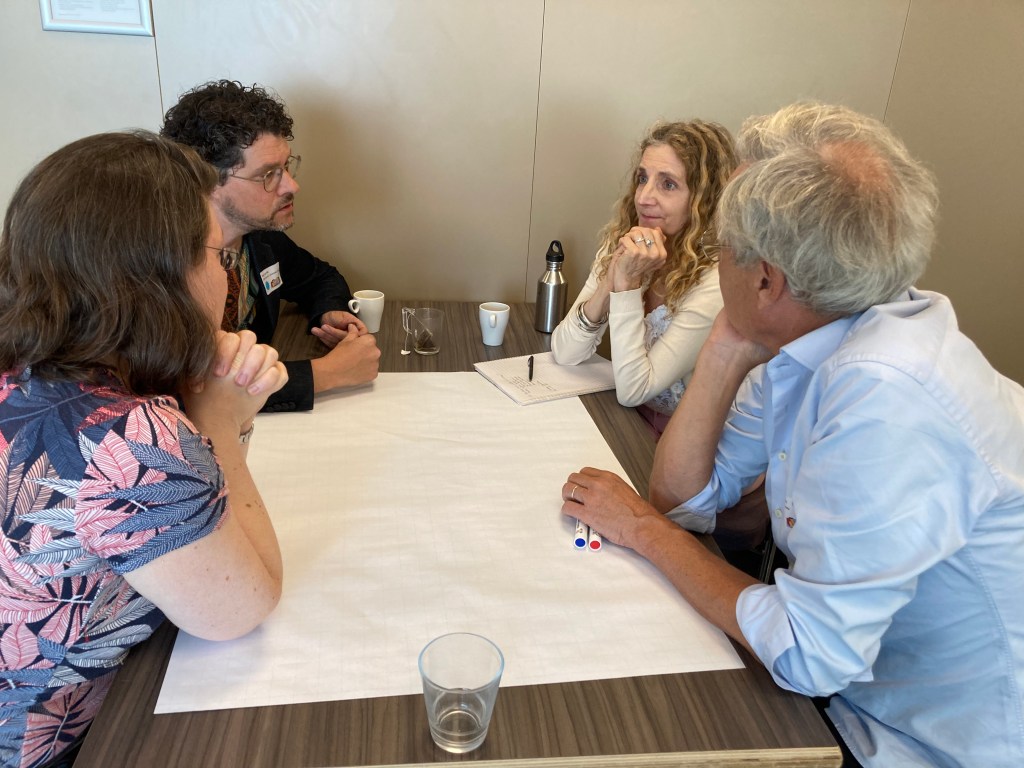
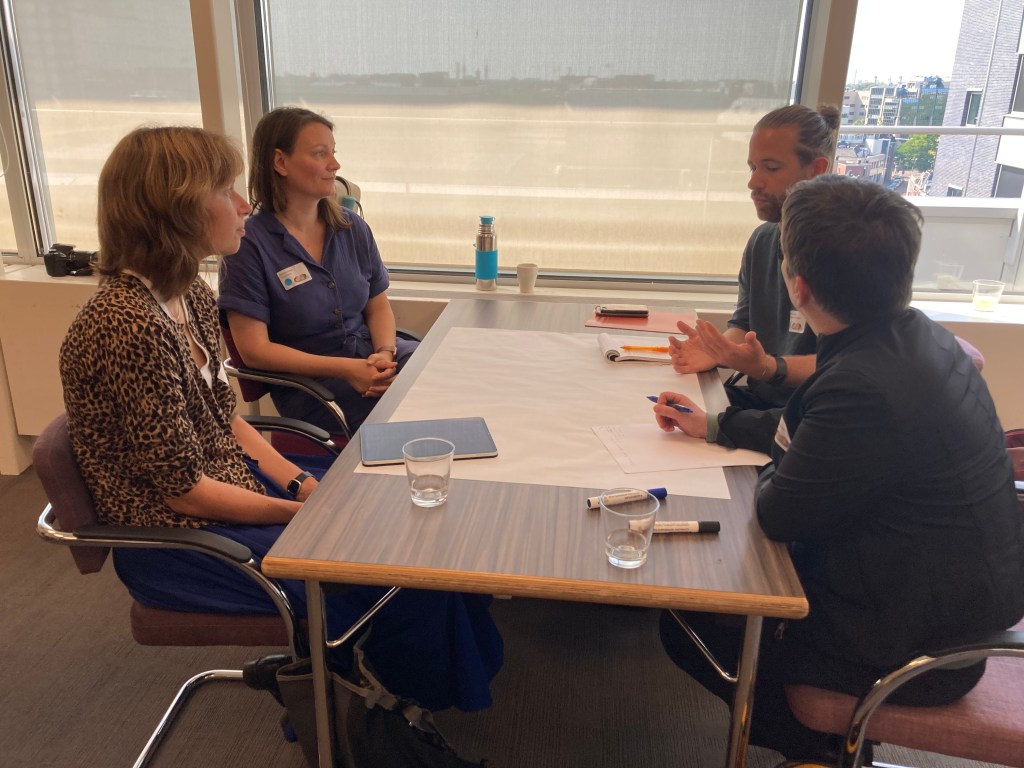
Following the lecture, participants attended workshops, in which they could choose one of the following areas:
- Research: in this workshop, Sarah de Rijcke (Leiden University) gave an overview of current (academic) developments in the field of research assessment. In the second part of the workshop, participants worked in subgroups by drawing up some responsible criteria for the appointment of a professor for the imaginary The Terra Nova Institute.
- Education: led by Marc van Mil (UMC Utrecht), participants discussed the recognition and rewarding of university teaching.
- Impact and engagement: in this workshop, Leonie van Drooge (LvD Impact & Research) and Rinze Benedictus (UMC Utrecht) gave an overview of the latest methods to measure impact and discussed the underlying principles. In the second part of the workshop participants applied these principles in an interactive exercise.
- Leadership: led by Ann Vanderhaeghe and Bruna Calado (Maastricht University), participants delved into the multifaceted realm of (self)leadership. Participants reflected on and engaged with each other on the significance of (self)leadership in fostering a thriving work environment.
- Open and Responsible Science: in this workshop, Louise Bezuidenhout and Ana Parrón Cabañero (CWTS, Leiden University) gave an introduction to monitoring Open Science. Participants discussed benefits and limitations of existing monitoring strategies. Recognising and rewarding Open Science activities was also discussed.
Panel discussion
After a short break, the workshop leaders gave a brief summary of the key insights from the workshops. This was followed by a panel discussion with five deans: Patrick Anderson (Engineering), Isabel Arends (Beta), Antoinette de Bont (Social Sciences), Marike Knoef (Economics and Business) and Thony Visser (Humanities). The deans expressed strong support for the Recognition & Rewards programme. For Knoef, Recognition & Rewards was even one of the reasons to become a dean, because in that role she can help realising the stated ambitions. Within their faculties, all five deans are actively involved in the implementation of Recognition & Rewards.
In the panel discussion, the importance of the dialogue and the significant differences between the academic disciplines quickly emerged. Moderator Rianne Letschert asked Arends about the concerns there might be among beta scientists about the impact of Recognition & Rewards. Arends did not deny that there are concerned scientists within her discipline, but she convinced the audience that there is strong support among beta deans for Recognition & Rewards. Within humanities, there is another issue: teaching responsibilities are disproportionately high for academic staff. Visser: ‘I think we actually do very much teaching. We also need good researchers.’
To actually realise the ambitions of Recognition & Rewards, role models for the new generation of academics are especially needed, Knoef argued, and this is currently lacking. De Bont argued that ‘team science’ helps a lot to start the conversation. We can ask questions like “What is fun for you?”, “What do you like?”. Because in the end, it is especially important that academics enjoy their work. It is a given that not everyone can be promoted to professor.
In the final part of the panel discussion, a specific example from TU Eindhoven was highlighted. ‘From September onward, TU/e academics will be required to write a biographical sketch as they climb the academic career ladder, reflecting on themselves and their vision in education, research, leadership, and impact. This is a new tool developed by our university for assessing and recognizing academics differently, thanks to Recognition & Rewards.’ According to Anderson this helps both the academics that like to present themselves in words as well as academics who like to give some numbers as evidence. Knoef responded that there is indeed a demand for an inspiring list of indicators that are feasible and acceptable to use where academics can choose from.
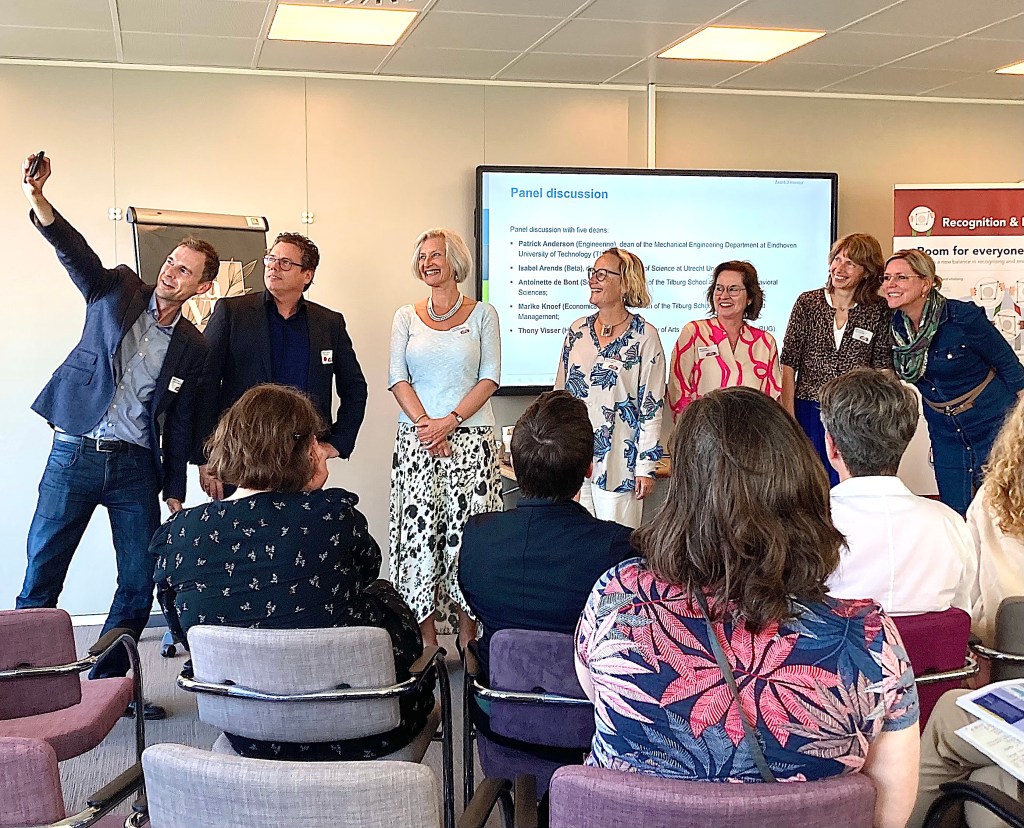
In her closing remarks, Letschert also reiterated the importance of good examples. Both the participants and the organisers looked back on an inspiring afternoon, full of energy and constructive discussion.
Leave a Reply