In 2022, Dutch universities and UMCs, together with the KNAW, NWO, and ZonMw, were among the first to sign the Agreement on Reforming Research Assessment (ARRA). This was hardly surprising, as the agreement aligns seamlessly with the goals of the Recognition & Rewards programme. For instance, ARRA advocates for the use of qualitative assessment criteria and the recognition of the diverse contributions of researchers.
Our universities and funding bodies were not only early signatories but also among the first members of the Coalition for Advancing Research Assessment (CoARA), a network established to support the ARRA agreement. Over the past two years, CoARA has grown from a small group of enthusiasts into a large international network of reformers, boasting over 700 members from Andorra to Zimbabwe.
Despite the strong Dutch involvement, the Netherlands still lacks a so-called National Chapter. A National Chapter is a local CoARA branch that helps members implement the goals of the Agreement on Reforming Research Assessment in their own country or region. This is particularly valuable because it allows us to amplify our voice within CoARA. Additionally, a National Chapter can share members’ experiences on an international stage during CoARA meetings. To date, 16 countries have established National Chapters, and CoARA regularly organises events for these chapters to exchange insights and experiences.
It is high time, therefore, for a Dutch National Chapter. This would enable us to participate in CoARA more cohesively, learn more effectively from other countries, and better share the lessons from our Recognition & Rewards efforts with the rest of the world. This is a crucial step, especially given concerns about the impact of Recognition & Rewards on the international mobility of researchers. CoARA demonstrates that the philosophy of Recognition & Rewards resonates internationally.
In recent months, we have been working hard behind the scenes to establish a Dutch National Chapter. The boards of NWO, ZonMw, the KNAW, and the Dutch universities have now approved its creation. We are currently awaiting final approvals before submitting an official request to CoARA. Hopefully, we will be able to share the exciting news early next year: the launch of our very own National Chapter!
On the 9th of December, 2024, representatives from CoARA member organisations joined together online for the CoARA General Assembly meeting. Coalition members came together to reflect on the year’s achievements and to create a shared vision with the CoARA community looking ahead to 2025 with the election of a new CoARA Chair and 7 Steering Board members, including Vice-Chair.
During the meeting, quorum was reached with fifty-six percent voter participation upon the closing of the vote to conclude the Steering Board elections on the 9th of December 2024 at 12h40 CET.
The new composition of the CoARA Steering Board:
Role in CoARA Steering Board
Name
Organisation
Country
CoARA Chair
Professor Henk Kummeling
Utretch University
The Netherlands
Vice-Chair (re-elected)
Dr. Karen Stroobants
Marie Curie Alumni Association
United Kingdom
Vice-Chair
Dr. Elizabeth Gadd*
International Network of Research Management Societies (INORMS)
United Kingdom
Steering Board member
Prof. Marcin Palys
European University Association (EUA)
Poland
Steering Board member
Dr. Irene Ramos-Vielba
Spanish National Agency for Quality Assessment and Accreditation (ANECA)
Spain
Steering Board member
Dr. Gabi Lombardo
European Alliance for SSH
Italy
Steering Board member
Prof. Cameron Neylon
Cutin University
Australia
Steering Board member
M. Hans de Jonge
NWO Dutch Research Council
The Netherlands
Steering Board member
Prof. Stanislaw Kistryn
Jagiellonian University
Poland
Steering Board
M. Janne Pölönen*
Federation of Finnish Learned Societies
Finland
Steering Board
Dr. Luciana Balboa*
Global Young Academy
Argentina
*Steering Board members who continue on their terms and were not up for election this year
Prof. Henk Kummeling, who has served as Rector Magnificus of Utrecht University since 2018 and is a member of Coimbra Group, replaces the first acting CoARA Chair, Prof. Rianne Letschert, as the new CoARA Chair.
Dr. Karen Stroobants was re-elected as Vice-Chair, to serve alongside current Vice-Chair, Elizabeth Gadd. Six newly elected Steering Board members join current Steering Board members, M. Janne Pölönen and Dr. Luciana Balboa. Newly elected members include, Dr. Gabi Lombardo, Prof. Stanisław Kistryn, Prof. Marcin Palys, Dr. Irene Ramos-Vielba, Prof. Cameron Neylon, and M. Hans de Jonge. To ensure a diverse selection of candidates, balancing mechanisms were implemented as criteria for the election, in terms of types of organisations represented, geographic coverage, gender, and diversity of disciplines and expertise.
A diverse Steering Board indeed makes better decisions for a diverse community. There is great value in having expert voices in the CoARA governance who share insights from the studyof research assessment practices as well as having those leaders on boardwho are in the position to drive change in research assessment in their organisations – and are committed to shape the reform both in their organisations as exemplary instances and on the level of a global coalition. – Professor Rianne Letschert
—
From the Dutch Recognition & Rewards programme we congratulate the new CoARA (Coalition for Advancing Research Assessment) Steering Board members! A special congratulations to Henk Kummeling, elected as chair, and Hans de Jonge, elected as a new steering board member. We are delighted to see these leaders step into such pivotal roles together with well-regarded leaders from other countries. It is good to see the diversity in backgrounds in the new CoARA Steering Board.
CoARA will also say goodbye to Rianne Letschert. We wish to offer her a heartfelt thank you for her impactful leadership as chair over the past two years. In this role, she has been a dedicated ambassador for changing assessment in academia, championing the vision of the Recognition & Rewards programme on an international stage.
We look forward to collaborating with the new Steering Board and supporting their efforts in the coming years!
—-
The General Assembly meeting of December 9th reflects the evolution of CoARA over the past two years, as captured in a statement by Professor Rianne Letschert,
During my time as Chair, CoARA has grown and evolved as a community. As Working Groups and National Chapters have created established communities of practices and the coalition now surpasses 700 members, CoARA has laid the groundwork for advancing more inclusive and effective research assessment practices. I am honoured to have been the first CoARA Chair to see the community through its foundational stage of development and to support its evolution.
Looking forward to 2025, the Steering Board will be spearheaded by the newly elected Chair, Prof. Henk Kummeling, who will continue to shape the evolution of CoARA as memberships and outputs advance.
I am grateful for the opportunity to serveas Chair of CoARA during thispivotal phase in the Coalition’s development. With CoARA’s communities now established, we will build upon solid foundations to ensure the future prosperity and sustainability of CoARA. Leveraging my experience in both research and leadership of knowledge institutions, I am committed to supporting the vision of CoARA and its growing communities bydriving actionable change. – Professor Henk Kummeling, CoARA Chair
‘Reflection’ is such a central part of ‘Recognition and reward’, and so it was a pleasant consequence of being invited to write and read this column that it’s pushed me to reflect on what it means to work in a diversified and talented team, and how the development of such teams can be incentivised.
During the plenary programme of the Recognition & Rewards Festival, Karen Stroobants (Vice Chair of the Coalition for Advancing Research Assessment) delivered a column titled “The sum+ team: more than the sum of its talents.”
Reflecting on my own experiences as a starting point, a key observation has been that the drivers that have held together the various teams I’ve been part of over time, and across sectors, have been wide ranging.
Some teams were only identified as such through having a common line manager, and, admittedly, a lot of shared frustration, and operated on a very individual basis to deliver their work. Others were driven by a strong sense to support one another and make contributions to each other’s work though still very much in a quid pro quo way and through the lens of individual achievement. And then there’s been the teams that were really held together by a shared commitment to a common goal, the teams that added up to more than the individuals within them.
This observation begs the question: what distinguishes the latter from the former? Personally, I’ve experienced the goal-driven team much more in roles outside academia, and in voluntary roles, and generally I have observed a persistent focus on the individual within university-based research teams. So, assuming my anecdotal understanding has any representative value, two options seem to present themselves for those who would like to be part of a team that’s more than the sum of its talents (I’ll refer to this as the sum+ team going forward). Either look for a role outside academia (and not just any role, you’ll need to be selective there as well) or contribute to a culture shift away from the individual and towards the sum+ team within academia.
Given the audience here today, I suggest we focus on the latter. As a starting point, let’s explore some of the characteristics of the sum+ team and then delve into how changes to recognition and reward can enable these. To more clearly illustrate what distinguishes a sum+ team, I took inspiration from Dennis Sherwood, who describes a high-performing team through comparison with a football team or an orchestra.[1]
If we think about what distinguishes a football team from a random group of people running after a ball, or a harmonious orchestra from a discordant one, key characteristics include
that the football team or harmonious orchestra exists of a diversity of profiles that complement one another – the goalkeeper has vastly different skills from the striker, and the violinist has been selected for different strengths than the drummer; and
that it is steered by a manager or leader who can think strategically about what competencies, talents and backgrounds are required to form the sum+ team and bring together their team around a common goal – the success of a football team is often associated with its coach, and no orchestra takes to the stage without its conductor.
Building on these two key characteristics, I’d like to finish with a few concrete suggestions, aimed at those in the audience who are responsible for the recruitment, development and fostering of one or multiple teams – with sum+ potential, dare I add. And if you aren’t in a position to do so today, please hold on to these recommendations for when you might be in the future.
First, I recommend that funders, institutions and departments give more weight to the people management competencies of the team leaders they hire, promote and fund. The assumption seems to prevail that a good researcher by default develops into a strong team leader, while the competencies needed to deliver on these roles are vastly different. A good striker will not always be a good coach, nor is a good tubist necessarily a good conductor. More efforts are needed to ensure that where management competencies are required to deliver in a role or on a project, this is reflected in funding, recruitment and promotion criteria. This should include selecting for leaders who are able to set a common goal and strategically think about which skills and competencies are needed to deliver on it.
Second, I recommend that funders, institutions and team leaders stop ‘desiring five-legged sheep’ – a Dutch expression meaning ‘to look for so many qualities in a person that they probably don’t exist’. Currently, what is often expected of an academic is the equivalent of expecting a star goalkeeper to also be a talented striker and master passer or a skilled violinist to at the same time be a virtuous pianist and gifted drummer. Active efforts are needed to develop and recruit for different roles that each form an essential part of the team. This could include the recruitment of co-group leaders who for examples provide scientific leadership on the one hand and managerial skills on the other. Different roles should also lead into different career trajectories, inside or outside academia.
Third, I recommend that funders, institutions and departments reflect on what is appropriate to assess at the individual versus the team level, in addition to which criteria are most suitable to do so. In a team where individuals truly complement each other, the success of the team is a shared success – as for an orchestra, delivering a stunning performance relies on the contributions of all musicians. While there is a clear rationale for assessing competencies at the individual level, for outcomes and impacts, which relate more closely to the common goal, these are arguably better evaluated at the level of the team. The INORMS SCOPE framework sets out useful steps to evaluate only where necessary and can be a helpful tool to determine where and what to assess and how to do so responsibly.[2]
That concludes my suggestions towards assessment for sum+ teams. Whether you subscribe to these approaches or not, I hope you can agree with me that aiming for teams that are more than the sum of their talents, and driven by a common goal over individual ego, is worth our while – and I wish that you all can further explore ways of achieving this during the rest of the festival today.
Karen Stroobants – Vice Chair of the Coalition for Advancing Research Assessment Karen is a research policy adviser, specialising in research culture and research assessment. She is a Director at CultureBase Consulting and a Vice-Chair of the Coalition for Advancing Research Assessment. Karen was the penholder for drafting the European Agreement on Reforming Research Assessment in 2022 and led the development of the Royal Society’s narrative Resumé for Researchers in 2018.
Zodra Elizabeth Koier het vermoeden heeft dat wetenschappelijk beleid niet aansluit op de dagelijkse praktijk, gaat haar motor draaien. Als een mol graaft ze door het systeem, net zo lang tot ze de crux heeft gevonden. Ze wil dat mensen zonder overbodige stress hun werk kunnen doen. We gingen met haar in gesprek over de tandwielen van Erkennen & Waarderen en welke onderwerpen nog ‘hoognodig’ op tafel moeten. ‘Dit gaat over ménsen, ik kan me daar heel erg over opwinden.’
Of het nu tijdens landelijke bijeenkomsten over Erkennen & Waarderen is, of lokaal in haar eigen Groninger UMC: Elizabeth Koier laat haar stem horen. Het is haar er alles aan gelegen dat beleid de wetenschapper rechtvaardig ondersteunt. In Groningen heeft dit ertoe geleid dat er een commissie voor een intern verbeterprogramma is opgetuigd, binnen Erkennen & Waarderen nam ze deel aan de inhoudelijke programmacommissie van het Recognition & Rewards Festival én herkennen we haar als een trouwe deler van inhoudelijke kennis en ervaring op ons online community platform RRview.
Eén van de redenen met haar in gesprek te gaan, vormde de opmerking dat horizontale ontwikkeling pas voet aan de grond kan krijgen als het verticale carrière-pad anders wordt ingericht. Naar haar idee is dat het gesprek ‘onder’ erkennen en waarderen, de stap die voorafgaat aan bijvoorbeeld spreken over de beoordeling van kwaliteit.
De pyramide is weg
‘Ons systeem is niet bedoeld om mensen te bevorderen, maar om zo goed mogelijk onderzoek en onderwijs mogelijk maken. Vooralsnog geldt echter in de praktijk: je bent alleen wat waard als je omhooggaat. Daar moeten we vanaf. Mensen komen vaak bij mij voor carrièreadvies, elke keer weer hoor ik dat ze zich niet gezien voelen. Bijvoorbeeld omdat ze geen uitnodiging krijgen voor podia waar ze gezien hun expertise in passen. Puur omdat hun rang ontbreekt. Dat zit diep in ons denken: aan de ene kant wordt er heel progressief gesproken, maar toen er bijvoorbeeld bij ons een SEP-commissie moest komen, moest ik de blaren op mijn tong praten om te zorgen dat er een UD in kwam. Want ja, die hoort daar niet, daar zitten de hoogleraren.’
Dat de sporten van de academische ladder alleen naar boven toe fel oplichten, maakt in de ogen van Koier dat iedereen bij UMC Groningen met een vaste baan die zijn werk goed doet in feite hoogleraar moet worden. Zo ontstaat scheefgroei. ‘Bij onze UMC-praktijk is de piramide eigenlijk weg. Al het geld zit bij de hoogleraren. Een senior hoogleraar die bijna met pensioen gaat, verdient 2,5 keer zo veel als een startende UD. Dan begrijp je waarom het zo verschrikkelijk ingewikkeld is voor postdocs om hun weg te vinden. We moeten veel beter nadenken aan wie we die duurbetaalde functies geven en hoeveel we er daarvan hebben.’
Meer gewicht voor talent
Wat haar betreft zou een bevordering naar een topfunctie alleen logisch zijn als je ergens ‘enorm veel talent’ voor hebt. ‘Er zijn heel veel mensen die gewoon een goede onderzoeker zijn, moet je willen dat die UHD worden? Veel mensen die heel goed zijn in onderwijs en onderzoek willen eigenlijk helemaal niet leidinggeven. Waarom blijft het dan zo belangrijk? Vanwege de status. Dan denk ik: dan geven we dus onze mensen, die gewoon hun werk goed doen, veel te weinig eer. Nu ben je gek als je de verticale route negeert, iedereen heeft het daarover. Volgens mij hou je mensen geïnteresseerd door niet steeds op dezelfde parameters te sturen en daar druk op uit te oefenen. Dat kan alleen als je van die verticale druk afgaat. Als je teamwerk wilt stimuleren, moet je degene die het team het beste ontwikkelt UHD maken. Nu is de houding: je kunt iedereen leren om een goede leider te zijn. Ik denk van niet. Dat is vloeken in de kerk. Want alles gaat over academische excellentie en in dat perspectief ben ik nu echt totale onzin aan het verkondigen.’
Waarom gaat het zoals het gaat?
De kans dat Elizabeth Koier ‘totale onzin’ verspreidt, is niet zo groot. Niettemin, als ze al onzin verkondigt, dan is dat in ieder geval weloverwogen onzin. Er gaan grondige analyses vooraf aan de standpunten die ze inneemt. Om haar werk goed te kunnen doen, tekent ze ‘bomen’ die weergeven hoe het systeem waar ze mee van doen heeft functioneert.
Welke onderdelen zijn door welke schakels aan elkaar verbonden en zodra er een verbinding ontbreekt: hoe komt dat?
‘Ik stel mezelf de vraag: waarom doet elk element wat het doet, heeft het daar redenen voor? Niet alleen op papier, ook bij afdelingen en individuen. Soms krijg ik vragen waarvan ik denk: dat kan helemaal niet. Dat kan ik als respons teruggeven, maar ik vind het ook handig te achterhalen waar de vraag vandaan komt. Dan zie je dat er allerlei radartjes die in elkaar zouden moeten grijpen niet in elkaar grijpen. Daar kan ik vaak niets aan doen, maar ik neem ze wel mee. Zo probeer ik ook met E&W om te gaan. Als we willen dat mensen hun gedrag veranderen, moeten we in eerste instantie de redenen waarom ze zo doen veranderen.’
Drie tandwielen voor Erkennen & Waarderen
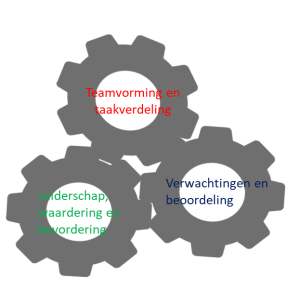
Voor de passende insteek van Erkennen & Waarderen bij UMC-Groningen kwam er ook een tekening. Het werden drie tandwielen die in elkaar draaien, met in elk tandwiel zijn eigen thema’s. Teamvorming & taakverdeling, Leiderschap & waardering & bevordering, verwachtingen & beoordeling.
‘Eén van de redenen dat teamvorming zo moeilijk is, is de druk naar boven én de druk op het individu. Wat mij betreft hebben al die onderdelen van erkennen en waarderen in zoverre met elkaar te maken, dat als je het één niet hebt gedaan, het ander niet gaat werken.’
Vervolgens is ze gaan uitwerken wat er moet gebeuren om de thema’s op elkaar in te laten grijpen. Onder meer hoe taakverdeling goed afgestemd moet zijn op beoordeling, hoe je denkkracht in een team evenwichtig en rechtvaardig verdeelt, wat de plek is voor valorisatie, zorg en impact. Het team als de graadmeter voor succes. En dat ook de financier alles in het werk moet stellen om de horizontale erkenning mogelijk te maken.
‘Het plan werd als te groot gezien.’
Wel mocht ze er ‘stukjes uit snijden’ om die uit te werken. Ze richtte drie commissies in voor de onderdelen onderwijsprofiel, maatschappij & valorisatieprofiel en tijdbesteding & horizontale ontwikkeling. ‘De prodecanen zien gelukkig de noodzaak hiervan.’
Opgetogen is ze over de veranderingen die de afgelopen jaren al een plek kregen. ‘Docenten hebben bij ons al wat langer een eigen carrièrepad. Er valt nog wel wat aan te sleutelen, maar er is beleid.’ Ook is er een plek voor maatschappelijke impact en valorisatie. ‘Onderzoek is bij ons niet meer de basis van alle beoordelingen.’
Maar: ‘Vervolgens blijkt dat vrijwel niemand weet dat die categorieën bestaan. De algemene gedachte is: alles anders dan UD/UHD/HGL bestaat uit postdocs. Dat is helemaal niet zo, er zijn onderzoekers- en docentenfuncties tot aan hetzelfde niveau als UHD-2. Er zijn allerlei mensen die al jaren goed bezig zijn en een vast contract hebben, die noemen zichzelf een postdoc. Want ja, geen idee. Ik ben nu op missie in het UMC om iedereen uit te leggen hoe het systeem werkt.’
Werkstress in plaats van werkdruk
Verlagen van de werkstress, daar gaat het voor Koier uiteindelijk over bij Erkennen & Waarderen. ‘Ik wil dat wetenschappers uit hun benarde positie komen. Ik zeg overigens expres niet werkdruk, omdat veel mensen daar een probleem in zien. Ze denken dat ik aan de werklast wil sleutelen. Dat is niet zo, ik wil aan de verwachtingen per individu sleutelen.’
En dan is de cirkel rond, de verwachtingen zijn verbonden met waardering en dus vooralsnog beoordeling. Om dat voor elkaar te krijgen moet je aan de bevorderingscriteria sleutelen. Niet alleen aan de criteria, maar ook aan de vraag: waarom willen we mensen eigenlijk bevorderen? Is er een positie voor een leidinggevende? Nee? Dan moeten we op een andere manier zorgen dat we die persoon erkennen. Bijvoorbeeld door wel die UD1 die hartstikke goed werk doet naar een internationale commissie te sturen. Dat kan best.’
Wat noemen we kwaliteit?
Een andere aanleiding voor dit gesprek vormde het onderwerp ‘kwaliteitscriteria’. Koier put professioneel uit een uitgebreid verleden als onderzoeker, waaronder voor het Rathenau Instituut, waar ze onderzoeker science & technology was.
Ze interviewde onder meer honderd decanen voor het Chinese borden-project, over de manier waarop financieringsstromen het beleid binnen de universiteit beïnvloeden. Met die bagage is ze een interessante expert op het vlak van beoordelingsmechanieken.
Op de criteria zelf wil Koier echter nog niet ingaan. Dat druist namelijk in tegen wat volgens haar de essentie is van deze thematiek. ‘Wat is nou kwaliteit, ik vind dat we bij het begin moeten beginnen. In plaats van bij de vraag ‘hoe kunnen we dat meten’. Het zou niet verkeerd zijn als we daar een soort gezamenlijk beeld van hebben, omdat de variatie al best groot is geworden. Het gaat telkens over de indicatoren, terwijl het in wezen bizar is dat we mensen iets willen laten beoordelen die dat eigenlijk niet kunnen beoordelen. We vinden gespecialiseerde vakgenoten te subjectief, maar vormen een dossier dat de graadmeter wordt, in plaats van het onderzoek zelf.’
Voor de helderheid schetst ze de context van het gegeven ‘kwaliteit en indicatoren’.
‘Iedereen moet excellent werk afleveren, terwijl er eigenlijk geen duidelijke definitie van dat begrip bestaat. Het komt er in feite op neer dat je beurzen binnen moet halen.
Ik deed bij het Rathenau Instituut onderzoek naar het Mattheus-effect: het verschijnsel dat iemand steeds meer beurzen en prijzen krijgt, zodra hij of zij er één heeft gehad. Dat is niet uit te leggen ten opzichte van iemand met een vergelijkbaar CV zonder prijs. De kansen zijn al klein, dat doet dus iets zodra iemand wint. Terwijl de verschillen in kwaliteit op dat niveau eigenlijk nauwelijks bestaan. Met het Mattheus-effect in ogenschouw maken we een loterij die aan het begin van een carrière speelt, daarna is iemand kansloos. Gelukkig hebben we ook aan kunnen tonen dat het niet zo extreem is, maar die manier van denken heeft allerlei kwalijke effecten.’
We moeten af van bevordering als enige beloning
Met zo veel roest op het systeem, rijst de vraag of ze verwacht de vruchten van Erkennen & Waarderen nog tijdens haar loopbaan mee te maken. Ze blijkt optimistisch.
‘Patricia Faasse was ooit mijn collega, zij schreef heel toegankelijk en inzichtelijk over de geschiedenis van wetenschapsbeleid. Ik las in haar boeken dat je maar vijftig jaar terug hoeft te gaan om te zien dat het hele systeem rond de ratrace nog niet bestond. Het is heel goed mogelijk dat de situatie er over vijftig jaar compleet anders uitziet. Ik durf niet te zeggen hoe!’
Koier ziet lichtpuntjes voor het medische domein als het gaat om de verdeling van het takenpakket. Ze kan zich vinden in gezonde academische teams, waarin evenredige aandacht is voor de verschillende leden.
Echter, ze benadrukt nog een keer: ‘Wat mij betreft zijn er binnen Erkennen & Waarderen nog lang niet genoeg incentives om de focus op het individu te verschuiven naar het team. We hebben het systeem zoals het was een beetje verbeterd. Maar we hebben ‘beloning voor goed werk is bevordering’ nog niet serieus aangepakt. Ik denk dat daar één van de grote schakels zit om echt de werkstress en de enorme druk op het individu aan te gaan.’
Profielen in elkaar over laten lopen
‘Je kunt mensen op dit moment eigenlijk niet behouden in een lagere positie, want je hebt ze niets te bieden. Je kunt ze niet uitdagen door ontwikkeling in een ander domein, zoals onderwijs of maatschappelijke impact. Iemand wordt namelijk beoordeeld via een standaard systeem. Als je op je CV een andere weg inslaat, voldoe je niet in het ene, maar ook niet in het andere profiel. Want iedereen kijkt de hele tijd naar je hele CV.’
Ze neemt als voorbeeld iemand die na jarenlang bepaald werk een andere kant op wil. Bijvoorbeeld meer richting maatschappelijke impact. Op dit moment is het nog zo dat er verwacht wordt dat iemand de onderzoeks- of onderwijslijn in stand houdt en dat andere pad er ‘gewoon’ naast doet.
‘Ik vind dat dit moet veranderen. Daar heb je voor nodig dat je zegt: die profielen moeten in elkaar over kunnen lopen. Je moet tijd gaan schalen. Welke tijd besteed je aan welke taak? Daar moeten de verwachtingen en beoordelingscriteria op worden aangepast. Dat laatste is iets wat je nog bijna nergens ziet.’
Ze ziet een schakel naar het criterium voor UD en UHD. ‘Dat zou naast doorgroeien ook moeten gaan over ‘wat heeft iemand gedaan’. Als iemand meer tijd aan onderwijs heeft besteed, is het logisch om meer gewicht toe te kennen aan onderwijs. Nu kan iemand die zich een paar jaar op onderwijs concentreert niet veroorloven om minder onderzoek te doen. Daar moeten we volgens mij vanaf. Dat botst echter nog met de competitieve financiering, waar altijd degene met de meeste toppublicaties wint.’
Melting clock – Salvador Dali
Wat doet iemand in de beschikbare tijd?
‘Ik denk dat NWO en andere financiers niet moeten kijken naar iemands hele CV, maar bijvoorbeeld naar wat iemand heeft gedaan met de beschikbare tijd. Als iemand in relatief weinig tijd iets heel moois heeft neergezet, is dat evenveel waard als wanneer iemand met geweldig veel onderzoekstijd iets productiefs heeft gevormd. Die laatste kan waarschijnlijk meer laten zien. Meer wordt doorgaans gezien als beter, daar ben ik het niet me eens.
Ik denk dat we op dat vlak nog een uitgebreid gesprek moeten voeren. Volgens mij is het mogelijk, je kunt kaders maken.
Er is natuurlijk een minimum. Als iemand twee uur in de week onderzoekstijd heeft, is dat gewoon te weinig. Dan moet je gaan kijken naar andere opties, of tot de conclusie komen dat er geen onderzoeksplek is voor die persoon. Zo kunnen handelen is nog wel een paar mijlen verwijderd van de situatie zoals hij nu is.’
Biografie Elizabeth Koier
De interesse van Elizabeth Koier (1982) voor wetenschapsbeleid ontstond terwijl ze als taalwetenschapper Oud-Grieks promoveerde. In die tijd was ze een jaar voorzitter van het PNN en kwam in contact met een professioneel lobbyist ‘die mij vroeg of ze direct of via mijn secretaresse een afspraak kon maken, haha!’. Vervolgens trok ze daar het hele jaar mee op en vond het fascinerend om te zien hoe je invloed kunt uitoefenen. ‘Ik leerde na te denken over het grote geheel, om mechanismes te analyseren en doorgronden en op de juiste plekken iets te veranderen.’
Min of meer toevallig vond ze na haar promotie een baan als onderzoeker wetenschapsbeleid bij het Rathenau Instituut. ‘Ik voldeed aan geen enkel criterium voor die baan, het leek me wel heel leuk. Ik deed daar het werk van een onderzoeker science and technology studies, dat kon omdat ik mezelf had leren programmeren.’ Daar was ze projectleider van het Chinese borden-onderzoek, waarvoor ze met collega’s alle decanen van universiteiten interviewde over hoe geldstromen binnen de universiteit lopen. Ook was ze onderzoeker in een project over wat gepromoveerden na hun proefschrift doen in de maatschappij ‘op basis van CBS-vragenlijsten voor 16.000 mensen’. Daar kwam het rapport ‘De zin van promoveren’ uit.
Na het Rathenau werkte ze achtereenvolgens bij het ministerie van OCW en de Erasmus Universiteit, tot ze op haar huidige honk als beleidsadviseur onderzoek bij het UMCG terechtkwam.